Marcus
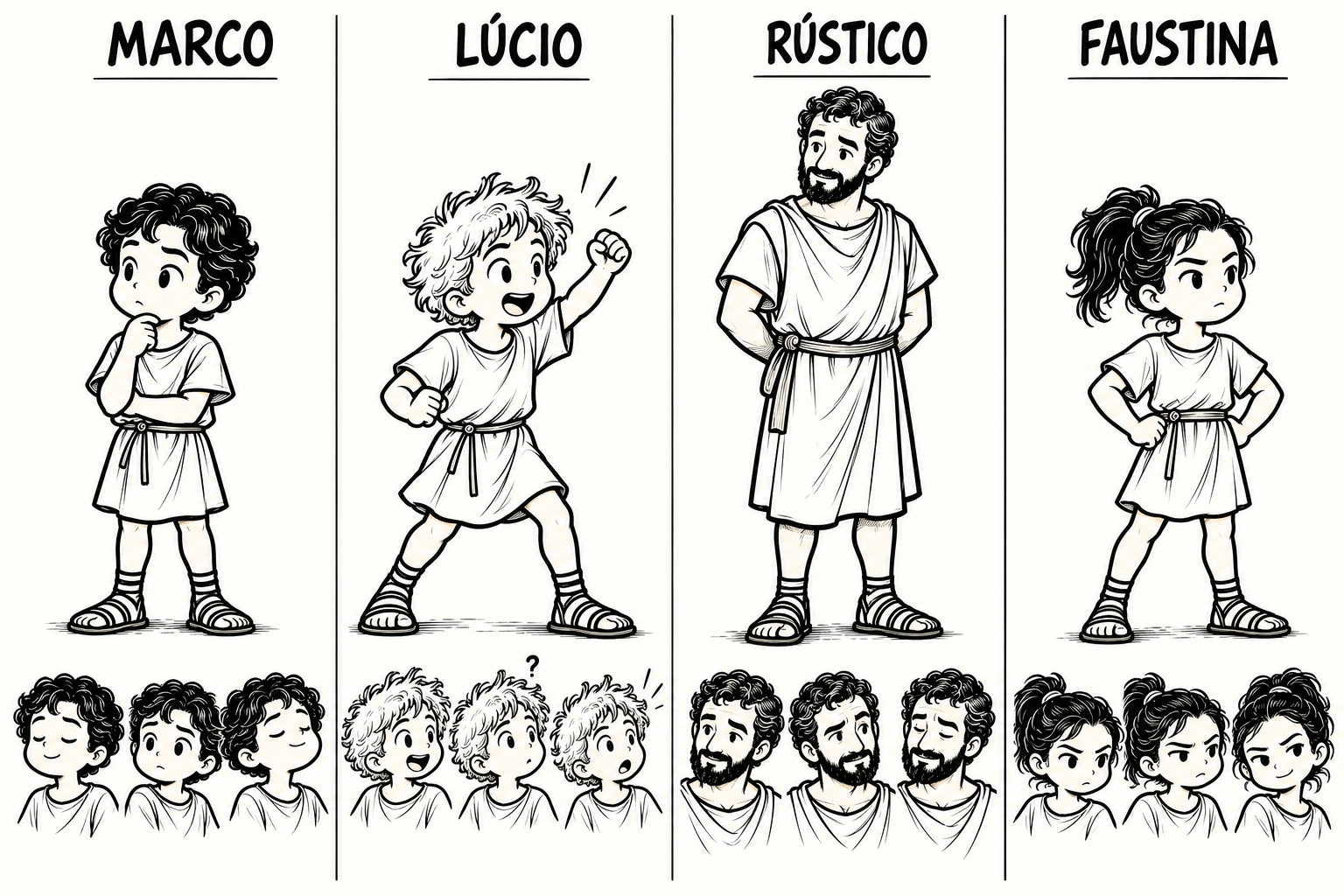
The protagonist
He wants to do the right thing and look grown-up. He turns maxims into very orderly plans — even when philosophy happens to support what he already wanted.
Ancient wisdom. Very childish problems.
A class of little philosophers, great certainties, and problems that almost never wait for the theory to finish.
This is where philosophy meets school life — and usually misses recess.
The protagonist
He wants to do the right thing and look grown-up. He turns maxims into very orderly plans — even when philosophy happens to support what he already wanted.
The literal friend
He would rather experiment, play, and solve things with his hands. One simple question from Lucius can dismantle an entire speech.
The practical force
She does not wait for the discussion to end before starting the solution. Direct and determined, she can turn cooperation into competition.
The tutor
He teaches with few words and precise questions. Rather than explain everything, he watches the children discover exactly where their own argument fails.
Each brings a very particular philosophical talent to school — and a new way to complicate lunch.
The great explainer
He wants to look capable and prepared. The more embarrassed he becomes, the more elegant, lengthy, and impossible to interrupt his explanation gets.
The idealist
He seeks a solution so perfect that the available problem usually has to wait. For Plato, the ideal approach would be to start again.
The classifier
He observes, separates, and names every detail with admirable precision. Sometimes he finishes classifying after everyone else has finished lunch.
The rule keeper
He applies every principle with unshakable consistency. The rule may produce an absurd result, but Cato will produce a very disciplined absurdity.